


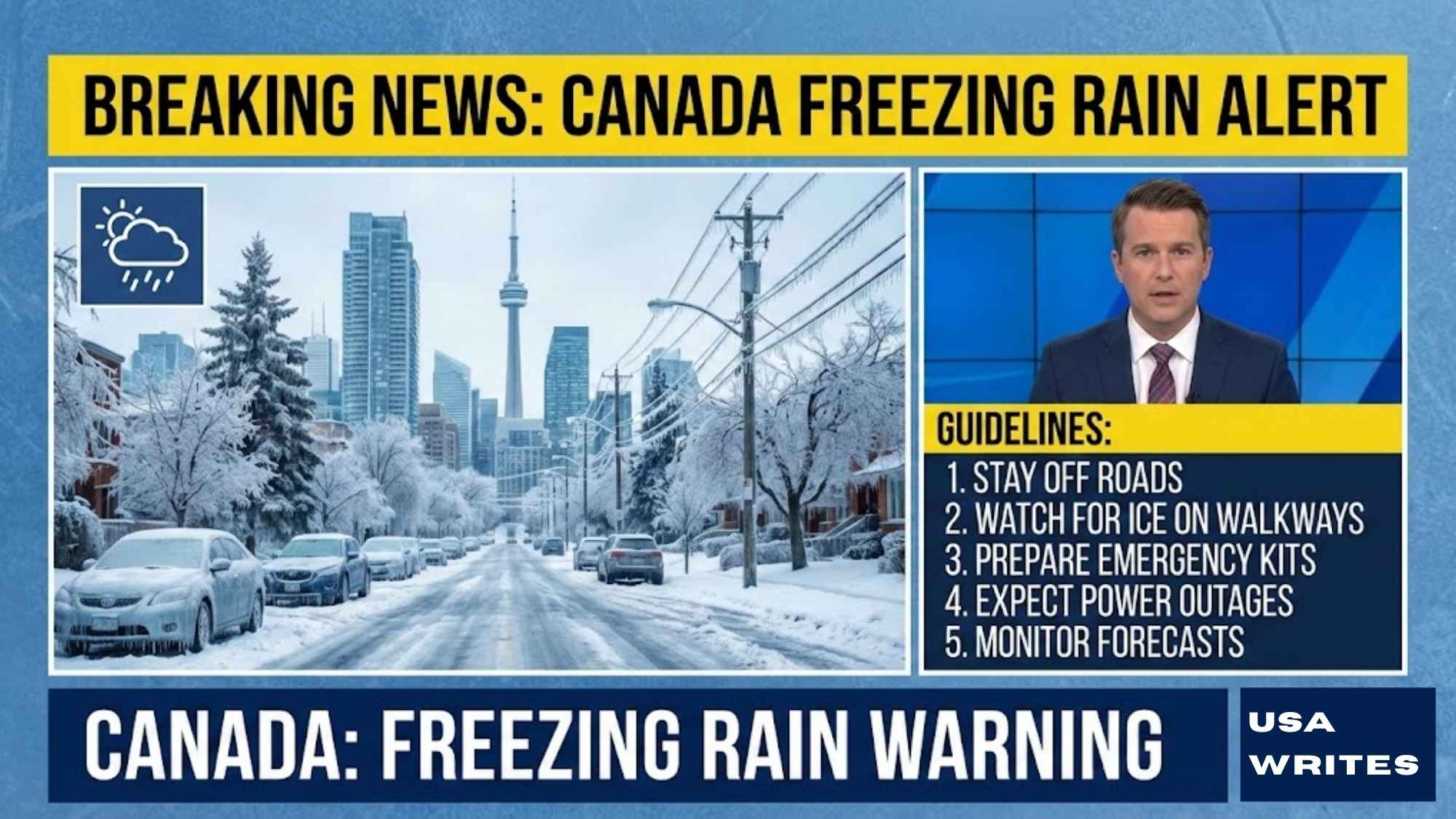
Freezing Rain Warning: Issued when ice accumulation of at least 0.25 inches is expected. Rain falls as liquid but freezes instantly upon contact with cold surfaces, creating a heavy glaze of ice. This is distinct from sleet (frozen pellets) or snow.
Unlike a snowstorm, freezing rain does not pile up; it coats everything in a heavy shell. A mere quarter-inch of ice can add 500 pounds of weight to a single span of power lines. This warning signals an immediate threat to electrical infrastructure, tree stability, and travel safety.
If you have just received this alert, your window for preparation is closing.
Key Actions Required Immediately
- Stay Off Roads: Travel becomes nearly impossible once accumulation starts.
- Pre-heat Your Home: Raise the thermostat 4°F above normal to bank heat against outages.
- Park Away from Trees: Ice-loaded branches can snap without warning.
- Charge Devices: Ensure phones and power banks are at 100%.
With the definition clear, we must move quickly to the practical steps required to protect your property before the first drop falls.
Phase 1: The 24-Hour Countdown (Preparation)
Once the warning is active, you typically have a short timeframe before conditions deteriorate. This phase is about fortification. The primary danger isn’t the cold itself, but the likely loss of power.
The Power Outage Protocol
Freezing rain causes “ice loading.” When ice exceeds 0.5 inches, widespread power outages are statistically probable as lines snap or towers buckle.
Heat Preservation Strategy: Do not wait for the power to cut out. Increase your home’s temperature immediately. If the power fails, this stored thermal energy keeps the house habitable longer. Identify a “Warm Room”—ideally a central room with few windows—where the family can retreat. Close off doors to unused bedrooms to consolidate heat.
Digital Preparation: A charged phone is useless if cell towers are overloaded. Download offline maps of your area. Ensure you have a battery-operated or hand-crank radio. Information is your most valuable resource when the grid goes dark.
Vehicle Fortification
If your car is parked outside, freezing rain can encase it in a shell of ice that is incredibly difficult to remove without damaging the paint or glass.
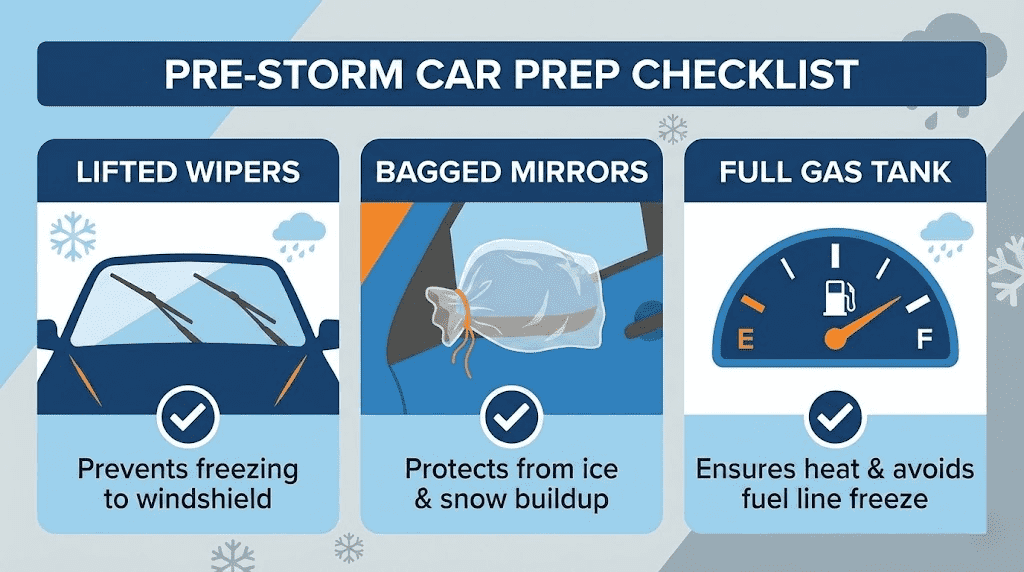
The “Wiper Lift” and Mirror Defense: Lift your windshield wipers off the glass. If left down, the rubber blades will bond to the windshield. Trying to pry them loose later often tears the rubber. For side mirrors, place a plastic Ziploc bag over the housing and secure it with a rubber band. When you remove the bag later, the mirror underneath will be ice-free.
Pre-Treatment: Do not wait until the ice forms to think about removal. Spray your windshield with a commercial de-icer or a homemade mixture (two parts rubbing alcohol to one part water) before the storm. This lowers the freezing point on the glass surface, making it harder for the ice to bond aggressively.
With your vehicle secured, you must turn your attention to the exterior of your home, where the risk of injury is highest.
External Home Defense
Standard rock salt is most effective as a preventative measure. It works by preventing the ice-pavement bond, not by melting thick ice sheets after they form.
The Salting Rule: Apply a layer of rock salt or liquid brine to your driveway and walkways before the precipitation starts. Once freezing rain hits untreated concrete, it creates a “glaze” that is nearly impossible to chip away without damaging the surface.
Tree Triage: Visually inspect trees near your driveway and power lines. Look for “widow makers”—dead branches that are already compromised. If you can safely remove them from the ground before the storm, do so. If not, move all valuable property away from the drop zone.
Phase 2: Surviving the Event (During the Warning)
When the rain starts, the environment changes from hazardous to deadly. The visual cues of freezing rain are deceptive; roads often look wet, not icy.
The Myth of “Just Wet Roads”
Black ice is the primary killer during these events. It forms when the road surface is below 32°F (0°C), but the air temperature is slightly warmer. The rain creates a transparent layer of ice that blends perfectly with the asphalt.
How to Spot Black Ice: Look for a glossy, dark sheen on the pavement. A key indicator is your tires: on a wet road, tires create a spray of mist. On black ice, there is no spray. If the road looks wet but your tires are silent and producing no mist, you are driving on ice.
Driving Survival (If Forced to Drive): If you must drive, disengage cruise control immediately. Cruise control can cause your wheels to spin uncontrollably if you hit a patch of ice. Use the “Eggshell Technique”: imagine there is a raw egg under your gas and brake pedals. Press them so gently you wouldn’t break the shell. Stopping distances on ice can be 10 times longer than on dry pavement.
Pedestrian Safety: The Penguin Walk
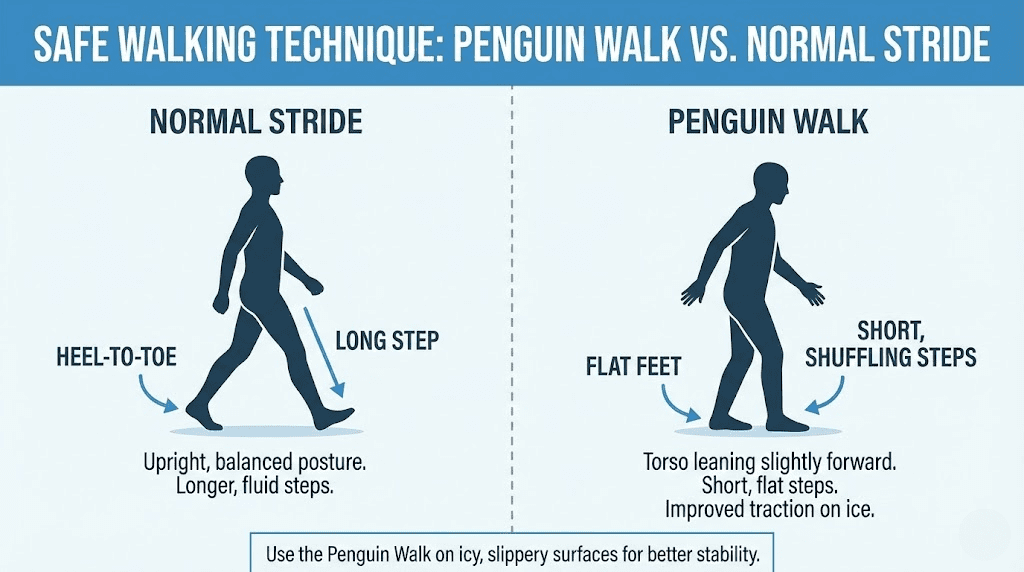
Walking to the mailbox can result in a concussion. To navigate icy surfaces, shift your center of gravity forward. Keep your hands out of your pockets to maintain balance. Take short, shuffling steps. This is often called the “Penguin Walk,” and it keeps your weight perpendicular to the ice, reducing the risk of a slip.
While you navigate safely outside, you must also manage the critical systems inside your home to prevent catastrophe.
Managing Utilities
If the power fails, your pipes are at risk of bursting as the house cools.
Pipe Protection: If the indoor temperature drops below 55°F, open cabinet doors under sinks to let warmer room air circulate around the pipes. Allow faucets on peripheral walls to drip slightly. Moving water is harder to freeze.
Generator Safety: Carbon monoxide (CO) poisoning spikes during ice storms. Never run a generator in a garage, basement, or within 20 feet of windows. The colorless, odorless gas can kill a family in minutes. Ensure your CO detectors have fresh battery backups.
Phase 3: The Aftermath and Recovery
Once the warning expires, the danger shifts. The “thaw” period brings falling hazards and water damage risks.
Assessing Ice Damage
Do not rush to chip ice off your roof. Climbing a ladder placed on icy ground is a leading cause of post-storm ER visits.
Roof Inspection: Check for ice dams from the ground. These are freezing rain warning ridges of ice that form at the edge of a roof and prevent melting snow from draining. If you see icicles forming behind the gutter or water stains on your ceiling, you likely have a dam. Use a roof rake from the ground to gently remove snow, relieving the pressure.
The “Thaw” Hazard
As temperatures rise, the ice bond breaks. Sheets of ice weighing hundreds of pounds can slide off sloped metal roofs or fall from tall buildings.
Vertical Awareness: Avoid walking directly under eaves, power lines, or tall trees during the initial thaw. This phenomenon, sometimes called “ice shedding,” can turn falling ice into dangerous projectiles.
FAQ: Quick Problem Solving
At what temperature does freezing rain occur? It typically occurs in a narrow band between 30°F and 32°F (-1°C to 0°C). It happens when a layer of warm air sits above a shallow layer of cold air near the ground. You can read more about this atmospheric structure on Wikipedia: Freezing Rain.
Can I use hot water to de-ice my windshield? No. Pouring hot water on icy glass causes rapid thermal expansion, which will likely shatter your windshield instantly. Use lukewarm water or a dedicated de-icing fluid.
How long does a Freezing Rain Warning last? These freezing rain warning usually cover a period of 4 to 12 hours, but the resulting ice can remain on surfaces for days if temperatures stay low.
Conclusion: Respect the Ice
A Freezing Rain Warning is a signal to stop moving and start securing. The glaze it creates is deceptive and destructive. By pre-heating your home, salting your walkways early, and understanding the mechanics of black ice, you move from a passive victim of the weather to an active protector of your home.
Next Step: Locate your main water shut-off valve now. If a pipe bursts during the freeze, knowing exactly where this valve is can save you thousands of dollars in water damage.
