


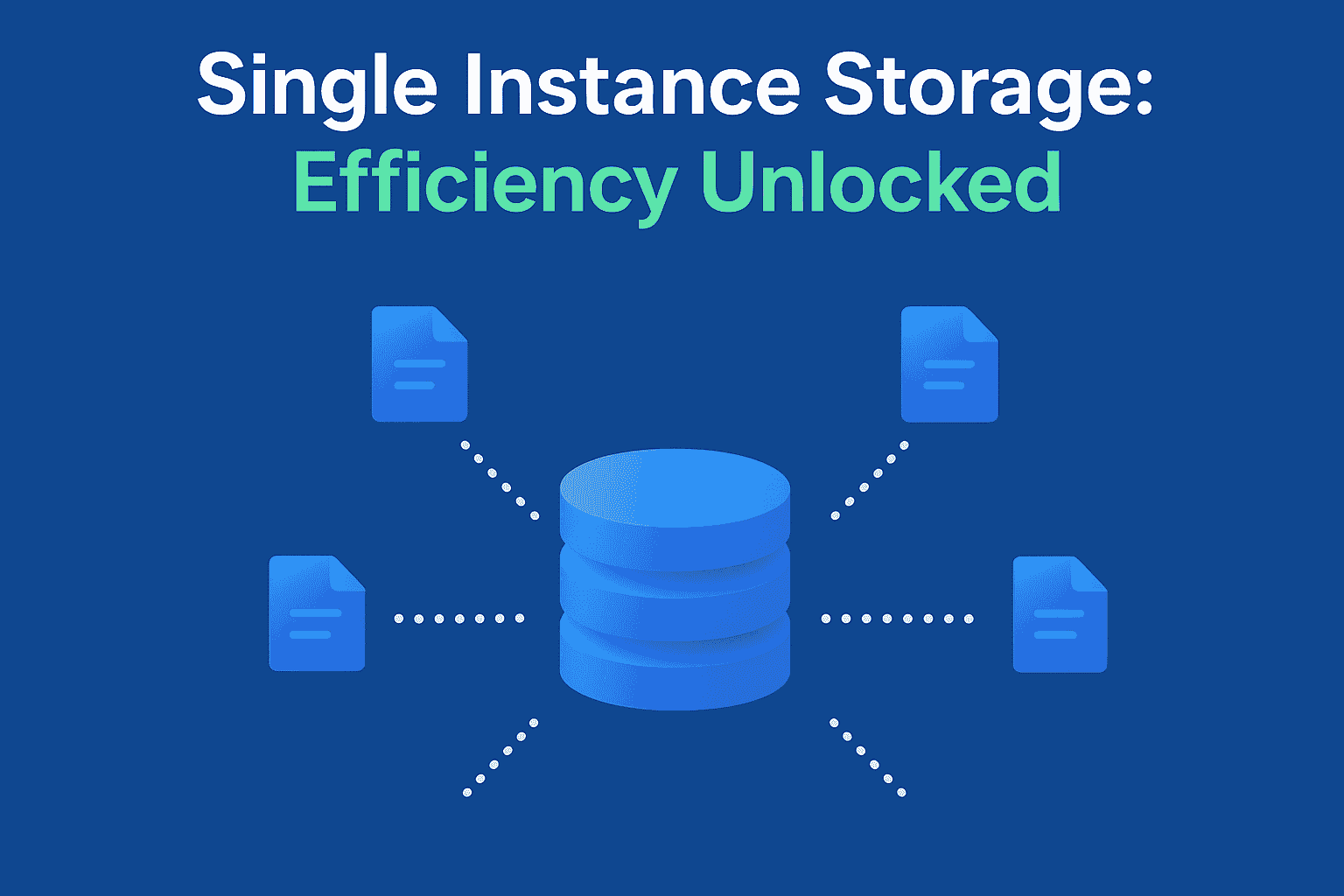
Introduction to Single Instance Store
In the era of exploding data volumes, organizations seek efficient ways to manage storage without compromising performance. A single instance store emerges as a powerful solution, enabling systems to store only one copy of duplicate files while maintaining multiple references to it. This technology, often abbreviated as SIS, revolutionizes data management by reducing redundancy and optimizing resources. Whether you’re handling backups or archiving emails, understanding single instance store can transform your storage strategy.
What is Single Instance Store?
Defining SIS Technology
Single instance store refers to a data deduplication method where identical files or data blocks receive a single physical copy on the storage medium. Multiple logical references point to this shared instance, ensuring seamless access without duplication. Developers and IT professionals actively implement SIS in various environments, from enterprise servers to cloud infrastructures.
Evolution of Single Instance Store
The concept of single instance store traces back to early file systems in the late 1990s. Microsoft pioneered its integration into Windows 2000, where SIS facilitated hard links for shared storage. Over time, advancements have expanded its role. Today, active innovations drive SIS adoption in modern platforms like AWS and Veritas Enterprise Vault, adapting to big data challenges.
How Does Single Instance Store Work?
Core Mechanisms Behind SIS
At its heart, single instance store operates through hashing algorithms. Systems scan incoming data and generate unique fingerprints—typically SHA-1 or MD5 hashes—for each file or block. If a match exists, the new data links to the existing instance rather than creating a duplicate. This process minimizes storage footprint while preserving data integrity.
Step-by-Step Process
- Data Ingestion: New files enter the system, triggering an active scan for duplicates.
- Hash Calculation: Algorithms compute hashes swiftly, comparing them against a stored index.
- Reference Creation: Matches result in pointers; unique data receives fresh storage allocation.
- Access Management: Users interact with files normally, unaware of the underlying sharing.
Engineers design these steps to handle large-scale operations efficiently, ensuring minimal latency.
Key Benefits of Implementing Single Instance Store
Storage Space Savings
Organizations achieve dramatic reductions in storage needs with SIS. For instance, in email archiving, duplicate attachments across thousands of messages occupy just one slot. Studies show savings up to 90% in redundant environments, freeing up terabytes for critical applications.
Cost Efficiency and Performance Gains
Beyond space, SIS cuts hardware and maintenance costs. Active procurement teams select SIS-enabled solutions to lower cloud bills. Moreover, faster backups occur because less data transfers, boosting overall system performance. Passive benefits include reduced energy consumption in data centers.
Enhanced Backup and Recovery
Backup software leverages SIS for streamlined processes. Tools like BackupAssist employ SIS to replicate only unique changes, accelerating restores. This reliability proves invaluable during disasters, where quick recovery minimizes downtime.
Use Cases for Single Instance Store
Enterprise Archiving and Compliance
In regulated industries, SIS shines for compliance. Legal teams archive vast document troves without bloating storage. Veritas solutions, for example, apply SIS to emails, ensuring auditors access complete records efficiently.
Cloud and Virtualization Environments
Cloud providers integrate SIS to optimize virtual machines. AWS instance stores, though temporary, inspire persistent SIS models elsewhere. DevOps professionals deploy it in hybrid setups, scaling resources dynamically.
Email and File Server Optimization
Microsoft Exchange servers rely heavily on SIS for mailbox management. Duplicate OST files in Outlook receive shared instances, easing server loads. IT admins report smoother operations in high-volume corporate networks.
Implementing Single Instance Store: Best Practices
Choosing the Right Tools
Select platforms with robust SIS features. Microsoft Learn resources guide Windows implementations, while open-source options like ZFS offer built-in deduplication. Evaluate based on your workload—block-level SIS suits databases, file-level fits documents.
Integration Challenges and Solutions
Deployment demands careful planning. Passive voice highlights that networks may face initial hash computation overheads. Mitigate this by staging rollouts and monitoring CPU usage. Active training ensures teams master configuration, avoiding common pitfalls like index corruption.
Measuring ROI
Track metrics such as storage utilization and backup times pre- and post-SIS. Tools provide dashboards for real-time insights, validating investments. Long-term, SIS delivers compounding returns through sustained efficiency.
Challenges and Limitations of Single Instance Store
Potential Drawbacks
Despite advantages, SIS isn’t flawless. High initial processing can strain resources in dynamic environments. Deletions require careful handling to avoid orphaned references, a task that demands vigilant maintenance.
Security Considerations
Shared instances raise risks if one reference compromises. Encryption layers protect data at rest, but admins must enforce access controls rigorously. Audits reveal that proactive monitoring thwarts most threats effectively.
Future Trends in Single Instance Store Technology
AI-Driven Enhancements
Emerging trends incorporate AI for predictive deduplication. Machine learning anticipates duplicates, preempting storage bloat. Researchers explore quantum-resistant hashing to future-proof SIS against evolving threats.
Integration with Edge Computing
As edge devices proliferate, SIS adapts for distributed systems. Lightweight implementations enable IoT networks to share data instances across nodes, optimizing bandwidth in remote setups.
Conclusion: Embrace Single Instance Store for Smarter Storage
Single instance store stands as a cornerstone of modern data management, delivering efficiency without complexity. By adopting SIS, businesses position themselves for scalable growth. Explore tools today and unlock the potential of deduplicated storage—your infrastructure will thank you.
(Word count: 1,012)
FAQs
What is the primary function of a single instance store?
A SIS primarily eliminates data redundancy by storing only one copy of duplicate files, referenced multiple times for access.
How does single instance store differ from traditional storage?
Unlike traditional storage, which duplicates files entirely, SIS uses links and hashes to share instances, drastically cutting space usage.
Is single instance store suitable for small businesses?
Yes, small businesses benefit from SIS in backups and file sharing, with affordable tools like Windows SIS making it accessible.
Can single instance store impact data retrieval speed?
Generally, no—retrieval remains fast due to direct pointers, though initial setup may introduce minor delays in hash processing.
What are common applications of single instance store in cloud services?
Cloud services apply single instance store for VM optimization and archival, reducing costs in platforms like AWS and Azure.
